
The gentleman next to Amy looked every bit of 85 and he did not look familiar, it was his voice that I believed I knew. He had one of those voices for radio: crisp, articulate, compelling. A few moments earlier he and his wife had sat next to us at Camp’s chef’s counter. If you haven’t been, Camp is one of our town’s stellar restaurants. Its interior positively sparkles with modern touches, and Chef Diego Campos’ food is always a delight to the senses. We were there for an early anniversary celebration and after we would head to the Peace Center for the JJ Grey concert. I sat on Amy’s left side and the gentleman sat on her right. After a few courses the two of them engaged in small talk and again, his voice felt so familiar.
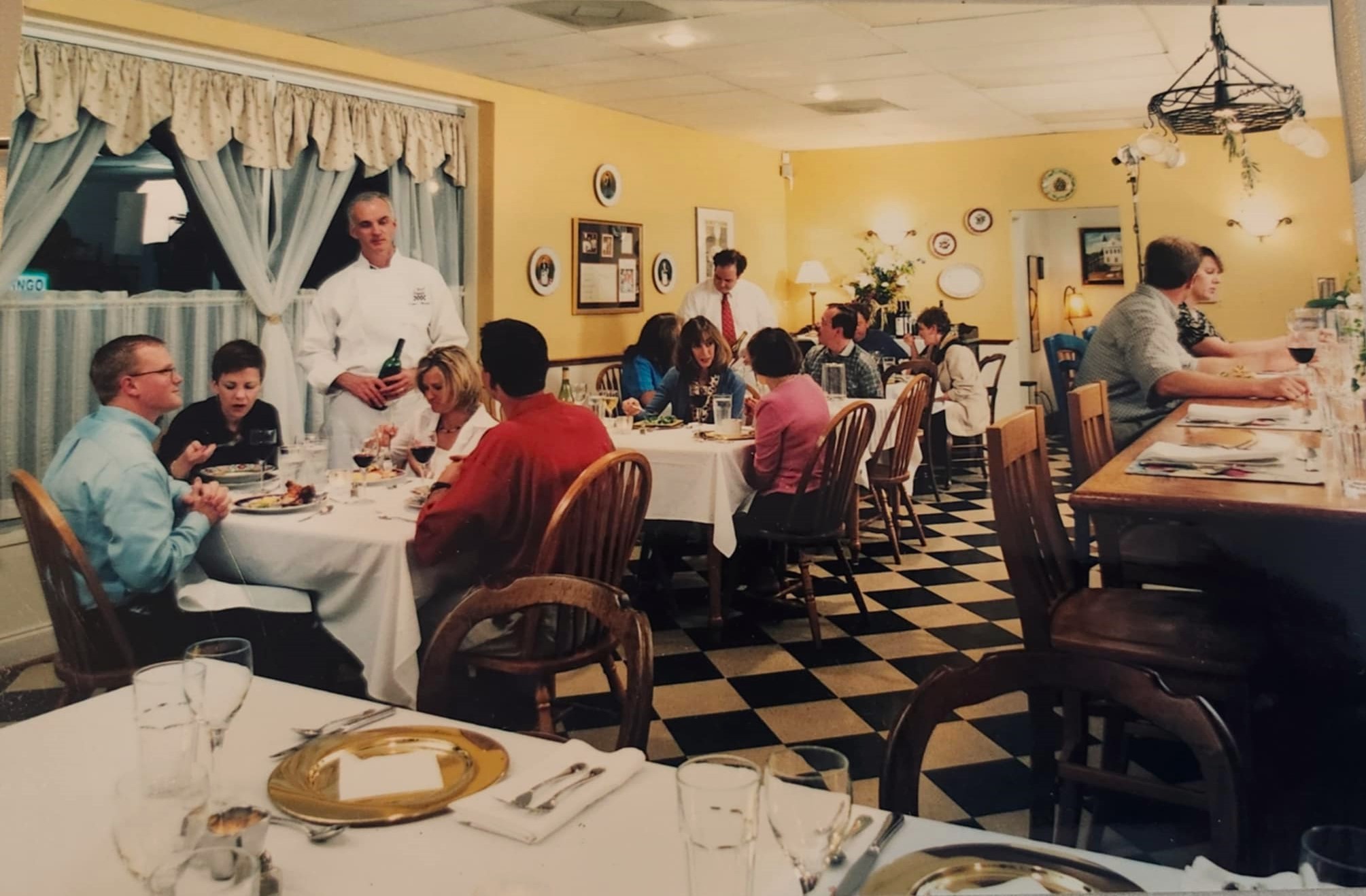
Amy and I met in culinary school in New Orleans and by providence we ended up working at the same restaurant. We became teammates, then friends, then lovers and at some point, we discussed our future. Cooking on a high level, a chef’s life, was what we desired. Amy has a degree in studio art, mine is in literature and our new medium would be in food. When we were young newlyweds we often discussed our own restaurant. What would it look like? What would we serve?
I knew going in that restaurant life would be tough but that was what I found attractive. It was a culture that valued strength, determination, stamina, and art. It bordered on an athletic endeavor. The first couple of chefs I worked under had one critical rule, my way or the highway. They were French, had grown up in Paris and had thrived in hospitality under the austere conditions of post-World War II France. One of my early lessons centered around profiteroles, those airy delights we know as cream puffs. Profiteroles are made from pate a choux, the dough also used to make eclairs. As the new cook, I was subjected to Chef Roland’s (pronounced: roe-lahnd) continual barrage of insults (“your mother fed you too much Jello as a child” or “you know what your problem is, you are totally stupid and know nothing about cooking”) meant to find my weak point. He was certain I would soon crack and find a new career, until the day he showed me how to make profiteroles. This was four months into my 18 months with him and that day he glared at me and with his hard Parisian accent announced, “We will make profiteroles.” While he stood over me and directed with a rubber spatula, I boiled a gallon of water, added several pounds of whole butter and stirred while it melted, then added what felt like five pounds of flour and stirred the warm dough vigorously while Chef berated me.
“Faster monsieur and always the same direction. Clockwise. And do not slow down. Come on, faster.”
Then I stirred in the eggs, lots of eggs. One at a time, with a wooden spoon. Always with a wooden spoon. The whole process took a good thirty minutes and was done by hand. Then we stuffed that warm batter into a pastry bag and Roland showed me how to pipe them out and bake them in a hot oven, then cool oven to achieve that traditional look of a tiny cabbage. When he was satisfied with the result, he complimented me with a nonchalant shrug of the shoulders and, “we will use them” then he smacked me, hard, on the side of the head with his rubber spatula. When I protested with “What the hell, Chef!?” He stuck that spatula in my face and declared “Now you will remember this lesson for the rest of your life!”
To Roland, those ingredients, flour, water, butter, eggs were precious and they were to be treated with respect. A proper cook could turn those humble ingredients into something delicious, and artistic. We made our own vanilla ice cream, placed a small scoop inside a trio of profiteroles, and served them with a very warm dark chocolate sauce. Simple, beautiful, delicious.
That night at Camp, while I watched Sous Chef Flynn and his cooks quietly, deftly managing the flow of tickets, I overheard the older gentleman tell Amy that our 33 Liberty was one of his favorite restaurants they’d ever dined in. He bragged about the cities, near and far, they had visited and repeated that our restaurant was near the top of their list.

“I sure do miss your restaurant.”
And all I could think of was Chef Roland smacking me with his rubber spatula. Have I let him down?
Before we left, I thanked the gentleman for his kind words, and we headed off to our concert. The next morning, I told Amy that his words left me hollow. I felt as if I had let him and many others down because I had abandoned my pursuit of fine cuisine. It was an odd feeling and probably one that many chefs have felt. The pursuit of culinary excellence has a high cost, so much so that I cautioned my own children against that life. Yet it is incredibly rewarding and satisfying on so many levels.
Today most of my work helps chefs, and restaurants be profitable. It’s all behind the scenes stuff that centers around cost control and inventory management and it’s something I didn’t dream of doing when I was a young cook getting smacked around by a French chef, yet it’s something I’m really good at and naturally it’s critical to a restaurant’s survival. But life has a way of guiding us to where we are needed and I’m grateful to still play a (very small) part of this town’s culinary scene. The artistic expression of pretty plates of food with carefully constructed ingredients timed with the season’s best, now that is something I dearly miss.